
The Book
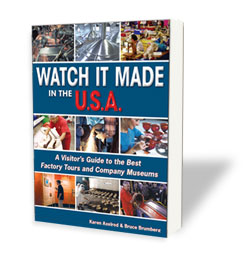
Watch It Made in the USA
Have you ever wondered how toothpaste gets into the tube? How stripes get on a candy cane? More than just a travel guide, Watch It Made In the U.S.A. helps you experience firsthand the products, companies, technology, and workers that fuel our economy.


Welcome to your guide to factory tours!

Ever wonder how the fortune gets into the fortune cookie? How toothpaste gets into the tube? Or how sheet metal is welded into a shiny new car or motorcycle? Having traveled thousands of miles and personally visited hundreds of factory tours since 1992, we invite you to explore some manufacturing mysteries of the world. Since most of the tours are free, and many give free samples, factory tours and company museums remain the best vacation value in America. Come along for the ride!

Also, see our review in the Boston Herald and our profile in Brandeis Magazine!

Your guide to factory tours,
Karen Axelrod
Karen Axelrod
Author and Factory Tour Consultant

Latest advice and tips from the authors
Hot Stuff
Tuesday, May 13, 2008 | Posted By Karen Axelrod in Factory Tours

The McIlhenny Company in Louisiana is the real Tabasco: it makes the world-famous brand of hot-pepper sauce. Now an international operation, the company grows its basic ingredient, the Capsicum frutescens pepper, in several countries to ensure a good harvest, sells its signature product in more than 160 countries and territories around the world, and prints its labels in 21 languages. Still, there is just one Tabasco factory, located west of New Orleans on Avery Island, Louisiana.

You'll know you're there as soon as you open your car door and catch a whiff of the piquant local aroma. Tours start with a film explaining that during the 19th century the company's founder created his Tabasco sauce (which takes its name from a river and state of Mexico) by mashing C. frutescens peppers with Avery Island salt, aging the mash in wooden barrels, adding vinegar, and then straining the mixture.

Along a corridor in the modern factory, you can see four lines of Tabasco sauce being bottled behind a long glass wall. The smell here is strong—but not nearly as strong as it must be inside the packaging room. Some lines produce more than 300 bottles of Tabasco sauce a minute, helping the factory produce at least 600,000 bottles a day.

After the bottles are spun around in the carousel and injected with the hot red-pepper sauce, they journey naked down the assembly line. Machines clothe the bottles with the familiar bright red octagonal caps, green foil neckbands, and diamond-shaped labels. The dressed bottles are then mechanically packed in boxes, ready to travel.

Burning with curiosity? See our book Watch It Made in the U.S.A. for more about this and other factory tours.


Holy Cow
Thursday, April 3, 2008 | Posted By Karen Axelrod in Factory Tours

Spring is a great time for taking not just factory tours but also farm tours, and in the pages of Watch It Made in the U.S.A. you can read about many tours of working agricultural sites, from the central valley of California to the cherry orchards of Michigan. One unusual farm you can tour is nestled in the Susquehanna River Valley of Pennsylvania—not too far from both Philadelphia and Baltimore. Located in Brogue, Hope Acres (www.thebrowncow.net) is one of only a few robotic dairy farms in the United States—yes, you read that right: a robotic dairy farm. Apparently, research shows that the best milk comes from happy cows who live comfortable lives. Thanks to the robotic technology of Hope Acres, its milk cows live in stress-free luxury with minimal human involvement.

A tour of the barn shows the cows' cozy conditions and the advanced technology that attends them. The cows stand or recline on thin waterbeds that cover the floor under a layer of sawdust. This forgiving surface helps to protect the cows’ joints, which (like yours) would become sore after hours of lying on a hard floor. If a cow has an itchy spot, she can saunter to an automated backscratcher—the cows have learned that this rotating stiff-bristle brush can scratch hard-to-reach places. Whenever a cow feels the discomfort of a full udder, she wanders into a room in which robots perform milking duties 24 hours a day. Laser-guided technology attaches the milkers, and the robots gently extract milk without causing the stress that human intervention can. Your guide will show you the “cow cookies” that help train the animals to seek the robots when their udders need to relieve the pressure of milk. Lastly, you visit the barn that houses new-born calves—always a treat for children.

For more information about this tour and many other agricultural tours throughout the country, see Watch It Made in the U.S.A.


To Boldly Go
Thursday, February 28, 2008 | Posted By Karen Axelrod in Factory Tours

We like to think both big and small about factory tours in the pages of Watch It Made in the U.S.A.—from tiny glassmaking studios to the giant manufacturing sites of heavy industry. Sometimes when we think big, we really think, well, BIG. This is why we chose to cover two tours of NASA facilities in the 4th edition of our book. We sketch them out below, but for the full coverage and all the information you need to take these tours, pick up a copy of Watch It Made.

Far out in Florida

No manufacturing operation in the United States is more ambitious than NASA's program for manned spaceflight at the Kennedy Space Center on Cape Canaveral (near Orlando) in Florida. Visitors get a detailed view of our past, present, and future technology for propelling astronauts into orbit, to the moon, and perhaps one day even to Mars. In some ways, it's the ultimate factory tour.

The basic tour, which you take on a bus, is available every 15 minutes and makes three stops. The first, Launch Complex 39 (LC 39), is where the space shuttles take off. A nearby observation platform, rising 60 feet high, gives visitors a fine view of the two immense launch pads. You can also see the Launch Control Center and the vast Vehicle Assembly Building, perhaps the biggest hangar in the world. Another stop is the facility in which NASA prepares parts of the International Space Station (ISS). You can walk through a mockup of the interiors. You also visit the Apollo/Saturn V Center. This cavernous facility preserves memories of the Apollo program, which culminated in the moon landings. The centerpiece is one of the original giant Saturn V rockets, the size of a building.

You can also take exciting special tours of the Kennedy Space Center. For details on these, see our full writeup in Watch It Made in the U.S.A.

California dreaming

Meanwhile, on the other side of the continent, NASA's Jet Propulsion Laboratory (JPL) in Pasadena, CA, is the Cape Canaveral of unmanned space exploration. Its teams of scientists and engineers, who have included the venerable Carl Sagan, work in numerous departments to plan, design, and build the spacecraft and satellites that probe our solar system. Among JPL's famous projects are the Viking Mars landers, the Voyager deep-space probes, the Galileo orbiter that explored Jupiter, and, more recently, the Mars rovers and the Cassini trip to Saturn. JPL also creates and commands satellites for monitoring Earth and its atmosphere and for studying the cosmos beyond our solar system.

The research and operational areas of JPL sprawl over a large campus. Depending on the interests of visitors and the focus of current missions, tours may visit any of several sites. After a multimedia presentation on the history of JPL, visitors see models of past NASA spacecraft and interactive exhibits which illustrate related science and engineering. Other areas you may visit include the mission-control center: the revealing images of Jupiter, Mars, and Saturn's moons that stunned the scientific world were received here. Given NASA's recent activities on Mars, you may also see the area where JPL tests new vehicles for exploring the Martian surface.

Amazed already? For the full details, consult Watch It Made in the U.S.A., where we also cover factory tours involving aerospace and aviation for use on Earth.


The Food of Love
Tuesday, February 12, 2008 | Posted By Karen Axelrod in Factory Tours

"If music be the food of love," begins Shakespeare's Twelfth Night, "play on." For those who are still dieting after a surfeit of sweets during the holidays, music may indeed suffice on Valentine's Day. Lots of factory tours involve music in one way or another. We summarize three below, but see our book Watch It Made in the U.S.A. for many others.

Highly strung

Paul McCartney, Willie Nelson, Eric Clapton: that's a nice trio for a guitar company to have on its list of customers. Indeed, since C.F. Martin Sr. started Martin Guitar in 1833, Martin acoustic guitars have acquired a loyal following among over a million musicians, whether they perform in arenas or in coffee-shops. On a tour of the facility in Nazareth, PA, you see many of the 300 separate steps—most still done by hand—of making a Martin guitar.

It takes between three and six months to make each instrument. Working in concert (sorry) with a variety of tools, craftspeople bend, trim, shape, cut, glue, fit, drill, finish, sand, stain, lacquer, and buff. Notice how a dovetail neck joint is carefully trimmed and then checked to ensure a proper fit with the body. After the tour, you can try your hand at playing some ax on a current model.

Including Neil Young and Bonnie Raitt, the client list of Taylor Guitar in El Cajon, CA, is equally illustrious. From a humble beginning in 1974, the company now builds thousands of acoustic and electric guitars every year. On the tour, you learn that one of the co-founders accidentally revolutionized the neck-attachment process because he did not know how to make the traditional dovetail to fasten the neck to the body. Instead of using glue, which impedes the transference of resonance and creates a deadening effect, he planed the surface of the body flat and bolted on the guitar neck, resulting in greater stability and a more articulate tone.

Now highly technological and adhering to rigid standards, the manufacturing process includes the use of computer-guided lasers, diamond-tipped cutting tools, and an ultraviolet light that bakes each guitar for 23 seconds to cure its finish. Meanwhile, the company's repair department tries to salvage damaged guitars—whether dropped during air travel or triumphantly trashed at the climax of a punk-rock show.

All keyed up

It takes a year and about 12,000 parts to make a Steinway piano. At the Steinway headquarters in Long Island City, NY, more than 500 craftspeople, trained by apprenticeship, hand-build 2,800 pianos every year.

A high point of the tour is the rim-bending. Six people carry a laminated rock-maple board (often with 18 layers) to one of the piano-shaped presses. They wrestle the wood, bending it around the press, and then hammer, screw, and clamp the wood into place. Each rim stays on the press for a day. Once removed, rims "rest" for at least six weeks in a sauna-hot darkened room.

Soundboards are custom-fit into each piano. Workers hammer in the bridge to which strings will be attached. Saws hiss and the floors vibrate with rhythmic banging and drilling. Cast-iron plates suspended in air wait for installation into rims. In the stringing department, workers attach each metal string to the plate (or “harp”), loop it tightly around the bridge, and then clamp it around the tuning pin. This process is repeated until all strings are installed.

The final stage is tuning. Master voicers in soundproof rooms regulate the key-and-hammer mechanisms (the "action"). To ensure that all hammers rise to the same height, voicers hit each key and watch the corresponding hammer bob like a woodpecker’s head. Once the action is regulated, the voicer inserts it into the front of the piano and tests its musical quality, adjusting its tuning and brightness.

If these tours sound like music to your ears, consult a copy of Watch It Made for more details of each experience and for other tours involving music.