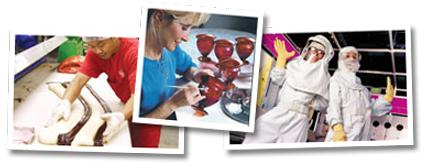


Ever wonder how the fortune gets into the fortune cookie? How toothpaste gets into the tube? Or how sheet metal is welded into a shiny new car or motorcycle? Having traveled thousands of miles and personally visited hundreds of factory tours since 1992, we invite you to explore some manufacturing mysteries of the world. Since most of the tours are free, and many give free samples, factory tours and company museums remain the best vacation value in America. Come along for the ride!
Also, see our review in the Boston Herald and our profile in Brandeis Magazine!
Your guide to factory tours,
![]()
Karen Axelrod
Author and Factory Tour Consultant
No manufacturing operation in the world is more ambitious than the NASA space program; so naturally, as factory tour mavens, we were thrilled by our recent visit to the Kennedy Space Center in Florida. NASA's major "spaceport" on Cape Canaveral is, after all, quite possibly the biggest of all the factory tours in our book Watch It Made in the U.S.A. Visitors get a detailed view of our past, present, and future technology for propelling astronauts into orbit, to the moon, and perhaps even to Mars.
In addition to spacecraft exhibits and two IMAX cinemas, the Kennedy Space Center and Visitor Complex offers a basic tour with numerous exhibits included in the general admission, along with special tours that require separate tickets. Leaving by bus from the Visitor Complex, the basic tour is available every 15 minutes and makes three stops (allow up to three hours for the tour).
The first stop, Launch Complex 39 (LC 39), is close to where the space shuttles take off. You can climb up the observation platform, rising 60 feet high, for a view of the two immense launch pads and a close look at a main shuttle engine. From the platform you can also peer back at the Launch Control Center and the vast Vehicle Assembly Building, the largest single-story building in the world (your tour bus passes close to this near the first stop). Shuttles awaiting launch may be visible in the distance.
The second stop is the Apollo/Saturn V Center. This cavernous facility preserves memories of the Apollo program, which culminated in the moon landings. Here you learn about the early space program and watch an exciting big-screen video of the Mission Control firing room during the Apollo 8 mission. From the turquoise rafters to the exhibits on the ground, you will see a lunar module, a rover training vehicle, and many other relics of the Apollo program. The centerpiece is one of the original giant Saturn V rockets, the size of a building.
The third stop is the facility where NASA prepares parts of the International Space Station (ISS). You can walk through an actual-size mockup of the interiors where astronauts will work and sleep. From the observation gallery, you see the processing floor where components of the space station are assembled.
The Astronaut Training Experience (ATX) is a special all-day interactive program that lets you sample the rigors that NASA crews must endure to prepare for missions (this program involves additional cost). The day also includes a general tour of Kennedy Space Center, simulators, and a simulated space-shuttle mission. Because the ATX is physically interactive, special requirements apply: call for details.
While that special tour costs extra, we found a nice free bonus with general admission to the Kennedy Space Center: admission to the U.S. Astronaut Hall of Fame (six miles west) is included.
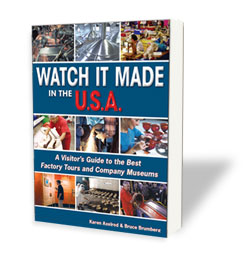
For more details about the Kennedy Space Center and other fun tours in central Florida, see our book Watch It Made in the U.S.A.
February 14 is like a second Christmas for Hallmark. The increasing commercialization of Valentine's Day has feverishly boosted demand for lavish pink and red greeting cards, whether silly or serious. Woe betide the man who forgets to give his sweetheart at least one of these on the 14th.
Couples who take their greeting cards really seriously can step into the world of Hallmark on a factory tour in Topeka, Kansas. After receiving safety instructions (stay between the marked lines), you enter an enormous manufacturing space. Your tour guide, who normally works there, begins the tour at the foil department. Hallmark's reputation for intricate detail is evident as you watch the application of foils in gold, silver, and other colors for captions, art design, and lettering on cards. Contrasting with this delicacy, your next stop confronts you with the massive machines that cut cards out of litho sheets and send them down a conveyor belt to be stacked. Next you walk past the die-cut machines, clanking and clunking away, to the screen-print operation, which applies ink to large sheets of stock. Each sheet travels along a 30-foot round conveyor to allow the ink to dry. Moving to the end of the manufacturing process, you walk through the areas for folding, quality control, and packaging.
Your last stop on the first floor is the huge area for envelope production. This is the noisiest room in the factory: the machines here produce over 3 billion envelopes every year for the whole of the Hallmark empire. Five-foot-high paper stock disappears into the machines and emerges as a completed envelope only a little larger than your hand.
If, after this up-close encounter, you still want more, you can visit the Hallmark Visitors Center in Kansas City, Missouri. Among many other points of interest, you can watch a technician make engraving dies—the metal plates that raise the three-dimensional designs on paper—or cutting dies, which work like steel cookie cutters to make unusually shaped cards. Two presses churn out cards you may purchase 10 months from now.
More details of both these sites, and many other factory tours, are available in our book, Watch It Made in the U.S.A.
Harry and David Holmes began mailing Royal Riviera pears around the country as mail-order gifts in the 1930s. Since then, their company has grown into a giant purveyor of edible gifts: the famous Harry and David, headquartered in Medford, Oregon.
The $5 it costs to tour the gift-packing factory is money well spent. The holiday season is a special time to take the tour, for you can witness the packing and wrapping of the Tower of Treats: five boxes, each containing a different product such as fruit, cookies, or cheese, are stacked in a tower and wrapped with a ribbon. From an overhead balcony, you can watch as each worker fills a box and passes it to the next person, who covers the box with a lid and adds another box on top. Once all five boxes are stacked, one member of a two-person team holds the ribbon, while the other wraps the ribbon around the tower and adds a bow and some baubles on top. Ribbons fly as each team assembles up to 1,500 towers a day.
Elsewhere, workers hand-pack exquisite baskets. Each packer receives a wooden box containing all of the components (e.g. fruit, preserves, nuts, candies), the basket itself, and a Styrofoam form resembling a cowboy hat. After the packer fills the basket, it is transported by conveyor belt to workers who cover it with cellophane and send it to the shrink-wrap machine.
In the bakery, workers prepare fruit galettes, cookies, and cheesecakes by hand. Sweet smells drift from the candy kitchen, where vats with rotating blades stir deep baths of liquid chocolate. Here you can watch workers pour the chocolate into molds. Then the candy goes through the enrober, the cooling chamber, and the cool room before being packed and frozen for later use in gift boxes.
Lots of other factory tours in Watch It Made are perfect for the holidays. Come to think of it, so is our book. You can order a copy right now on this website.
Eyewitness reports from Vermont say that this has been an especially good autumn for colorful foliage, and it's not too late to see the vivid hues of fall in southern Vermont. If you drive up scenic Route 7 north of Bennington, and have an interest in field sports, you may want to visit the home of the Orvis Company in Manchester, where the firm has been making fly-fishing rods since 1856.
The products of Orvis have greatly expanded since the company began. In fact, many people know Orvis now more for its widely sold line of clothing than for its fishing rods. However, the tour in Manchester is solely about the company's original core business of producing equipment for fly fishing. In addition to still crafting rods of the traditional bamboo, the company now also makes modern carbon-fiber rods. These are the industry standard for modern anglers who still enjoy the peaceful ancient pastime of fly fishing: wading into cold streams to catch trout with special rods and a wide array of lures exquisitely crafted to resemble insects.
You begin the tour by walking through hallways that display pictures of rod manufacture over the past century, while your guide talks about the history and craft of this profession. Most of the rods Orvis sells are made of various graphite composites, using materials and technology pioneered by the aerospace and defense industries. These techniques yield a powerful rod that is still sensitive enough for accurate line control and casting. The graphite needs to be stored in freezers in flat sheets. These are then turned into blanks that are cut into shapes, molded, and baked for almost two hours at 250°F. After sanding, the high-end rods get three coats of finish, finely polished with a final layer that blocks ultraviolet light. In the assembly area, 10 to 20 people put on the butts, cork grips, and guides.
You also see craftsmen fixing rods. Although Orvis rods rarely need repair and come with a 25-year guarantee, freak damage occasionally occurs in the wild—for example, when an angler is forced to use a rod to repel a bear! After such episodes, owners can send their rods to the factory for repair (with or without a good story).
Following the tour, you can take a lesson in casting at the edge of the nearby pond, which is stocked with trout, though hopefully no bears.
All of New England is gorgeous in the fall, and trees in the southern areas are showing peak autumn colors right now. For more ideas on factory tours in New England or anywhere else in the US, see our book Watch It Made in the U.S.A.